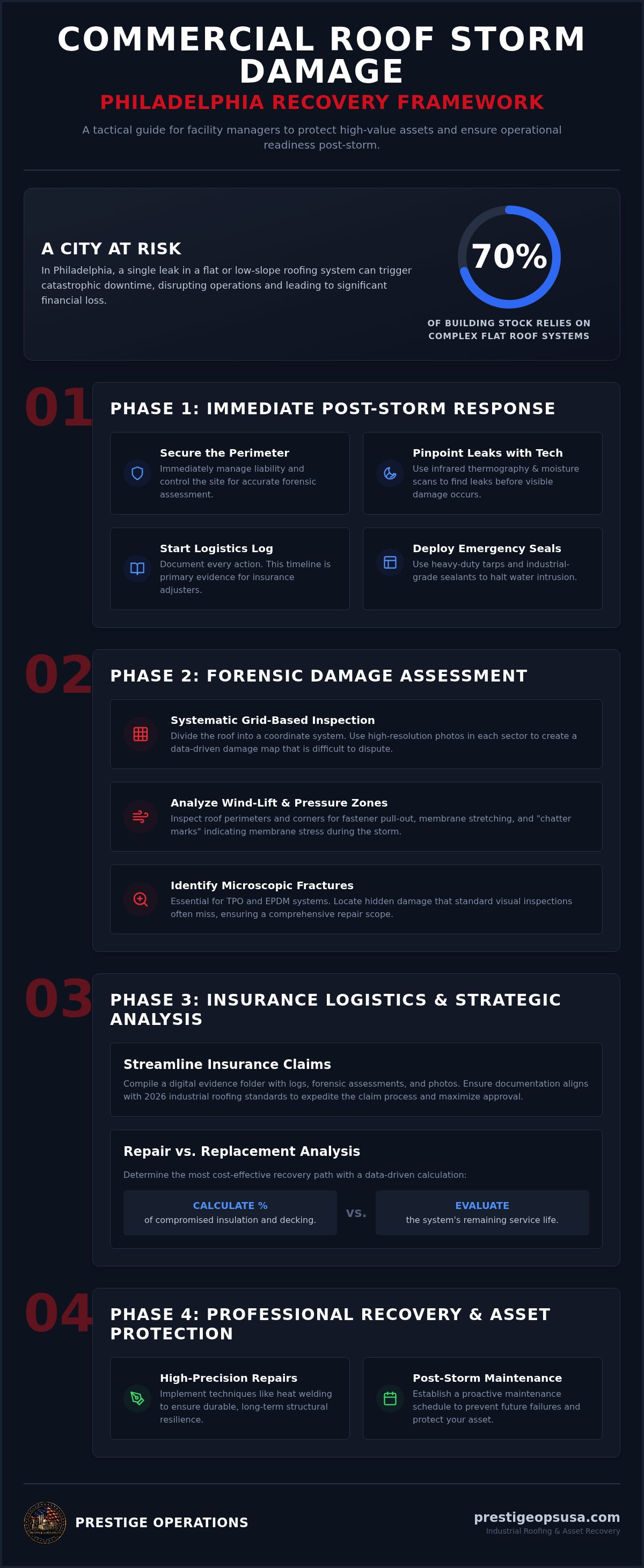
A severe storm doesn't just damage your roof; it tests your facility's operational readiness. In Philadelphia, where 70% of the building stock relies on complex flat or low-slope systems, one leak can trigger catastrophic downtime. You already know that reactive maintenance is a liability. You need a logistical strategy that protects your physical assets while satisfying rigorous 2026 insurance and regulatory standards. Execution must be precise to avoid structural instability or denied claims.
This guide delivers a decisive, industrial-strength framework for executing commercial storm damage roof repair Philadelphia. You'll gain a tactical recovery checklist designed to help facility managers navigate the transition to the 2021 International Building Code (IBC) and verify mandatory dual-licensing requirements. We detail how to conduct forensic assessments, secure the building envelope, and manage the 60-day proof of loss window with professional speed. From membrane separation to parapet wall stability, we outline the exact steps required to restore your roofing system to full operational capacity. This is about more than a repair; it's about strategic asset recovery in a high-stakes environment.
Key Takeaways
- Establish a secure perimeter immediately to mitigate liability and utilize interior moisture scans to pinpoint critical leak locations.
- Execute a systematic, grid-based forensic assessment to identify microscopic fractures in TPO and EPDM membranes during commercial storm damage roof repair Philadelphia.
- Streamline insurance logistics by compiling a digital evidence folder that aligns with 2026 industrial roofing documentation standards.
- Determine the most cost-effective recovery path by calculating the exact percentage of compromised insulation and decking compared to the system's remaining service life.
- Implement high-precision repair techniques like heat welding and establish a post-storm maintenance schedule to ensure long-term structural resilience.
Immediate Post-Storm Tactical Response
Stabilization is the first phase of any industrial recovery operation. After a severe weather event, you must establish a secure perimeter immediately to manage liability and eliminate safety risks for staff and contractors. This isn't just about safety; it's about controlling the site for forensic accuracy. Execute an immediate interior moisture scan to identify critical leak points before they manifest as visible ceiling damage. Identifying these points early prevents moisture from migrating into sensitive equipment or inventory areas. Don't wait for water to pool. Use infrared thermography to detect thermal anomalies in the insulation layers.
A proactive logistics log is essential for long-term recovery. Record every action, deployment, and observation starting from the initial assessment. This log serves as the primary timeline for insurance adjusters, proving that you acted with due diligence to prevent secondary damage. When executing commercial storm damage roof repair Philadelphia, these early records often dictate the success of the entire claim process. Document the exact time of the storm, the duration of the event, and the immediate impact on the roofing system's performance.
To better understand the scale of professional roofing response in the region, watch this overview of industrial operations:
Safety Protocols for Large-Scale Facilities
Never allow personnel on the roof surface until you verify structural integrity. Severe wind events can pull fasteners from the deck or weaken the underlying support system. You should consult established structural requirements for storm resistance to evaluate how the building envelope handled the pressure. Identify downed power lines or compromised electrical roof units immediately. Rooftop HVAC units are frequent failure points during high-wind events. Use high-visibility marking for all identified hazard zones to ensure no personnel accidentally enter compromised areas.
Emergency Tarping and Temporary Seals
Deploy emergency temporary weatherproofing to halt active water intrusion. For large-scale flat roof breaches, apply heavy-duty reinforced tarps that can withstand continued exposure. Standard materials often fail under industrial wind loads. Use industrial-grade sealants for temporary flashing and drain repairs to keep the drainage system functional. Effective water management prevents the ponding effect that leads to deck collapse. Ensure all temporary measures are documented with high-resolution photography before and after the application. This provides the forensic evidence needed to justify the cost of commercial storm damage roof repair Philadelphia and validates the necessity of the emergency intervention.
Forensic Storm Damage Roof Assessment Allentown PA
For commercial properties in the Philadelphia metropolitan area, post-storm recovery transitions from emergency stabilization to technical analysis. This meticulous approach is crucial for effective commercial storm damage roof repair Philadelphia, requiring a systematic, grid-based inspection of the entire roof surface to ensure no compromised area is overlooked. This methodical approach is the only way to validate a comprehensive scope. Large industrial roofs demand more than a visual walkthrough; they require a forensic review of every square. Divide the roof into a coordinate system and use high-resolution photography for every sector. This creates a data-driven map of the damage that insurance adjusters cannot easily dispute.
Wind-lift patterns typically concentrate at roof perimeters and corner zones where aerodynamic pressures are highest. You should analyze these areas for fastener pull-out or membrane stretching. Look for "chatter" marks on the decking, which indicate the membrane was lifting and dropping during the storm. This stress weakens the adhesive bond or mechanical fasteners even if the roof didn't blow off. While assessing long-term continuity, referencing resources like FEMA's Ready Business toolkit helps align your recovery plan with broader operational resilience standards. Identifying microscopic hail fractures in TPO and EPDM membranes early prevents the insulation saturation that leads to premature system failure.
Membrane-Specific Damage Markers
Different materials exhibit unique failure signatures. On EPDM systems, look for "star-cracking" or subtle bruising after hail events. These impact points may not leak immediately but will degrade the rubber membrane over time. For TPO roofs, inspect heat-welded seams for wind-induced stress fractures or delamination. Metal roofing requires a different lens; document panel denting and fastener back-out, which can compromise the system's structural diaphragm. A professional forensic roof audit ensures these technical details are captured for your records before secondary damage occurs.
Drainage and Perimeter Infrastructure
Your assessment must extend beyond the field of the roof. Verify that scuppers and internal drains are free of storm debris to prevent catastrophic ponding. High winds often displace coping metal and gravel stops, leaving the roof edge vulnerable to the next weather event. Inspect rooftop HVAC curbs and penetration flashings for movement or seal failure. These components are critical to the building's envelope and are often the first to fail under extreme pressure. Documenting the integrity of commercial drainage systems is a non-negotiable step in securing the long-term viability of your asset during commercial storm damage roof repair Philadelphia operations.
Insurance Claim Logistics and Documentation Standards
Successful recovery depends on logistical precision. Once the roof is stabilized, you must compile a comprehensive digital evidence folder containing date-stamped forensics. This isn't just a collection of photos; it's a legal and technical record of the storm's impact on your roofing system. You have exactly 60 days in Pennsylvania to submit a formal, sworn proof of loss statement. Missing this window can jeopardize the entire claim. Draft a detailed scope of work that aligns with industrial roofing standards to ensure your valuation reflects the true cost of commercial storm damage roof repair Philadelphia. Maintain a rigorous timeline of all communications with insurers and contractors to protect your interests if a lawsuit becomes necessary within the one-year limitation period.
Professional Forensic Documentation
Precision documentation is the foundation of a successful claim. You must capture wide-angle shots to show the scale of the damage and macro-level photos to highlight specific membrane failures. Utilize thermal imaging to detect subsurface insulation moisture that isn't visible to the naked eye. This data identifies saturated areas that require full removal rather than simple patching. Create a detailed roof map indicating every point of failure, from punctured membranes to compromised flashings. Following established FEMA reimbursement documentation standards ensures your records meet the highest level of scrutiny. This technical approach transforms a subjective assessment into an undeniable forensic report.
Navigating the Commercial Claim Process
Review your policy language immediately to determine if you're covered for actual cash value or replacement cost. This distinction dictates your recovery budget. Prepare for the adjuster's site visit by providing a pre-vetted damage report that details every technical deficiency found during your initial inspection. Don't leave the assessment solely to the carrier's representative. Ensure all code-required upgrades are included in the claim scope. For properties in Philadelphia, you must account for the transition to the 2021 International Building Code (IBC) effective July 1, 2026. These updates often require higher insulation R-values or enhanced wind-uplift resistance. Including these mandates in your initial filing prevents out-of-pocket expenses for mandatory compliance. A professional approach to commercial storm damage roof repair Philadelphia treats the insurance claim as a critical phase of the industrial repair operation, requiring the same level of mastery as the physical installation.
Strategic Repair vs. Replacement Analysis
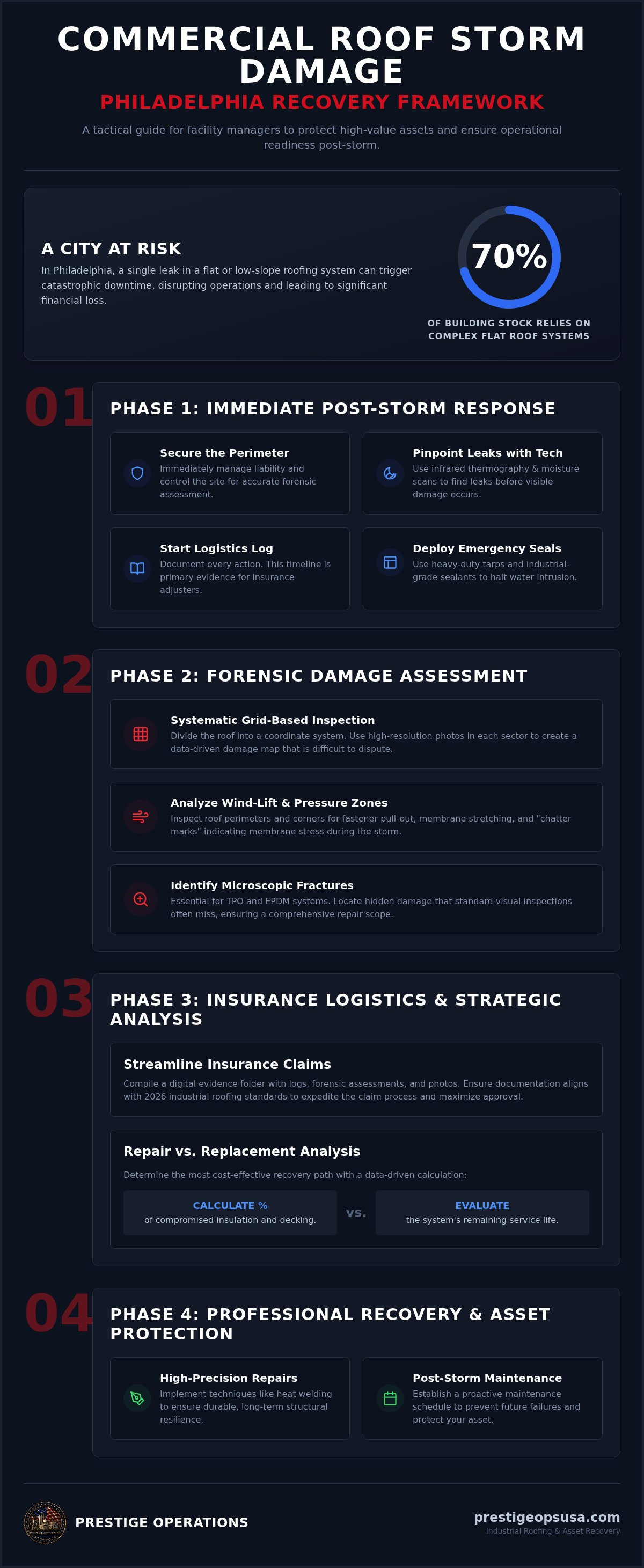
Recovery strategy hinges on asset valuation. You must determine if the existing assembly can support a localized restoration or if the storm has compromised its structural integrity. Assess the remaining service life of the system before committing to a scope. If a roof is at 80% of its expected lifecycle, a major repair is often a sunk cost. Calculate the exact percentage of compromised insulation and decking. Saturated insulation loses its R-value and promotes deck corrosion. This data drives the cost-benefit analysis between targeted commercial storm damage roof repair Philadelphia and a complete capital expenditure for a new system.
Manufacturer warranties are critical assets. Any intervention must comply with original installation specifications to keep NDL (No Dollar Limit) coverage active. Uncertified repairs can void the entire agreement. You need a partner who understands the technical nuances of membrane compatibility and warranty preservation. Schedule a strategic roofing analysis to determine the most viable path for your facility's long-term protection.
When to Choose Tactical Repair
Targeted repairs are viable when damage is localized to less than 25% of the total roof area. This threshold ensures the repair cost doesn't exceed the prorated value of the remaining system. The existing membrane must be within its primary service life and show no signs of systemic brittleness or seam failure. Most importantly, your forensic moisture scan must confirm that the internal insulation remains dry and structurally sound. If the core is dry, localized heat-welding or adhesive bonding can restore the envelope efficiently without a full tear-off.
Criteria for Full System Replacement
Systemic failure requires a full restoration. Widespread moisture infiltration into the roof assembly is the primary indicator for replacement. Once water enters the insulation, localized patches won't stop the spread of mold or deck rot. Systemic wind-lift, where the membrane has detached from the substrate across multiple zones, also necessitates a full tear-off to ensure structural stability. Finally, consider the 2026 energy code compliance in Philadelphia. The transition to the 2021 IBC on July 1, 2026, mandates specific insulation R-values and reflectivity standards. If your current system doesn't meet these requirements, a storm event is the strategic time to upgrade and ensure long-term regulatory compliance during your commercial storm damage roof repair Philadelphia project.
Professional Recovery Operations and Asset Protection
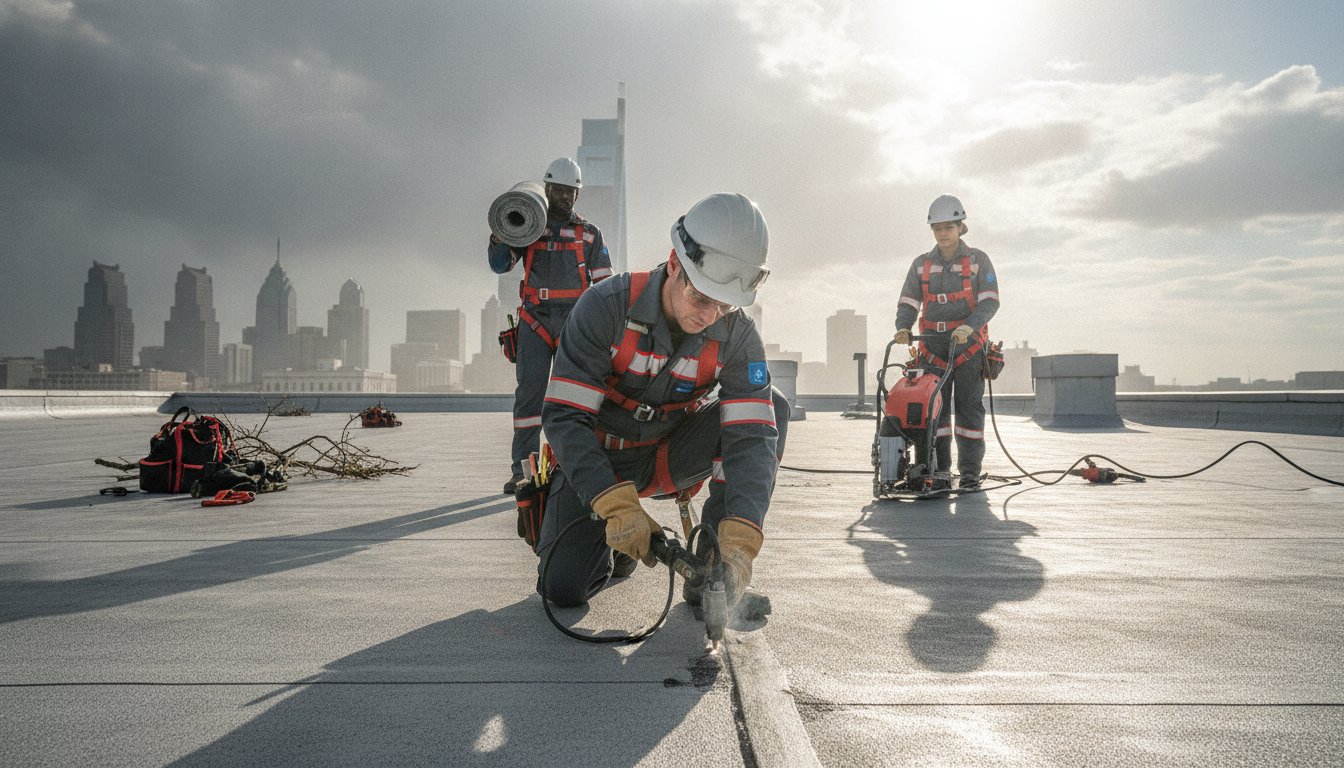
Execution is the final phase of strategic recovery. Once the scope is finalized, you must deploy high-precision repair techniques that restore the monolithic integrity of the roofing system. For TPO and PVC systems, this requires industrial-grade robotic heat welding to ensure seams are fused at the molecular level. For EPDM assemblies, use high-solids adhesives and seam tapes that meet 2026 industrial performance standards. These methods are far superior to temporary patches. They are designed to withstand the extreme hydrostatic pressure common during Philadelphia's severe weather cycles. Finalizing all manufacturer certifications is a critical administrative step. This ensures your commercial storm damage roof repair Philadelphia remains compliant with NDL (No Dollar Limit) warranty requirements, protecting your capital investment for its intended lifespan.
Precision Execution and Site Management
Operational continuity is the priority during the physical repair phase. You need strategic project phasing to minimize disruption to facility tenants or production lines. A clean, industrial-strength job site is mandatory for both safety and logistical efficiency. We don't just clear debris; we maintain a controlled environment that prevents secondary damage to the building envelope. Perform final forensic testing, such as vacuum bell tests on newly welded seams or electronic leak detection (ELD), to verify seal integrity. These tests provide the data-driven proof that the repair is successful. It's a "boots-on-the-ground" approach that prioritizes technical mastery over speed. This methodical execution ensures that the roofing system is fully restored to its pre-storm performance levels without compromising site safety.
Long-Term Asset Resilience
Recovery is the optimal time to fortify your facility against future Nor’easters and wind events. Integrate high-wind fastening patterns in all repair zones to exceed the 2021 International Building Code (IBC) requirements that Philadelphia adopted in 2026. This tactical upgrade increases the system's resistance to future uplift pressures. You should also implement a post-storm preventative maintenance schedule. Bi-annual inspections are the only way to identify minor membrane stress or drainage clogs before they escalate into catastrophic failures during the next storm. For Allentown facilities managing aging systems that can no longer support localized repairs, consider industrial roof replacement Allentown PA to ensure long-term tactical asset protection. Securing the facility against future volatility requires a shift from reactive fixing to proactive asset management. This ensures your roofing system remains a strategic asset rather than a recurring liability.
Secure Your Industrial Assets for the Next Storm Cycle
Successful recovery after a severe weather event is a high-stakes logistical operation. You've seen that reactive maintenance is a liability. Effective commercial storm damage roof repair Philadelphia requires forensic precision, rigorous documentation, and a deep understanding of the 2021 IBC standards. By following a tactical recovery plan, you transition from emergency response to strategic asset protection. You ensure that every weld and every fastener contributes to long-term resilience.
Prestige Operations brings industrial-strength reliability to every project. Prestige Operations provides strategic asset protection and rapid deployment for Philadelphia and Allentown facilities. Don't leave your facility's envelope to chance. Request a Tactical Storm Damage Assessment from Prestige Operations to leverage our no-nonsense industrial expertise. Your facility's recovery starts with a decisive, professional evaluation. Move forward with the confidence that your assets are protected by seasoned experts.
Frequently Asked Questions
How quickly should a commercial roof assessment be conducted after a storm?
Conduct the assessment immediately after the storm subsides and structural safety is confirmed. Pennsylvania insurers require prompt notice to initiate the recovery process. You have a 60-day window to file a formal proof of loss statement. Delaying the inspection risks secondary moisture damage and potential claim denial. Early documentation ensures every industrial asset is accounted for before secondary environmental factors complicate the forensic evidence.
Does insurance cover the full cost of commercial roof replacement in Philadelphia?
Coverage depends on whether your policy specifies Replacement Cost Value or Actual Cash Value. Most industrial policies cover the cost to return the roof to its pre-storm state. However, the transition to the 2021 IBC in Philadelphia on July 1, 2026, means repairs might require mandatory upgrades. Check for an "Ordinance or Law" provision in your policy to see if these code-mandated improvements are covered under your current agreement.
What are the signs of hidden storm damage on a flat TPO roof?
Look for microscopic punctures, seam delamination, and fastener "chatter" marks on the roof deck. TPO membranes often hide impact damage that doesn't immediately cause an interior leak. Utilize infrared thermography to detect thermal anomalies within the insulation. These temperature variances indicate subsurface moisture saturation. Identifying these markers early is essential for commercial storm damage roof repair Philadelphia to prevent systemic rot and structural instability.
Can hail damage be repaired without replacing the entire commercial roof?
Tactical repairs are possible if the impact damage is limited to specific zones. If the underlying insulation remains dry and the membrane is within its primary service life, you can execute heat-welded patches. This restores the monolithic seal without a full system tear-off. However, if hail has compromised more than 25% of the surface, a full restoration is usually the more cost-effective logistical choice for long-term asset protection.
How do Philadelphia building codes affect commercial roof repairs in 2026?
Philadelphia's adoption of the 2021 International Building Code (IBC) on July 1, 2026, significantly impacts repair specifications. All new roofing work must now meet enhanced energy efficiency and wind-uplift standards. This includes specific insulation R-values and fastener densities. Any commercial storm damage roof repair Philadelphia project initiated after this date must comply with these updated codes to secure necessary permits and pass final municipal inspections.
What is the difference between emergency tarping and a permanent repair?
Emergency tarping is a temporary stabilization measure designed to halt active water intrusion and manage immediate liability. It is not a structural solution. Permanent repair involves industrial-strength execution, such as robotic heat welding or high-solids adhesive bonding. These methods restore the system's original engineering specifications. While tarping buys time for the insurance adjuster's visit, only permanent repairs ensure the long-term resilience of the building envelope.
Should I file an insurance claim for minor wind damage on an industrial roof?
You should document and file for all wind-related damage regardless of the perceived scale. Minor wind-lift can pull fasteners or weaken the adhesive bond between the membrane and the deck. These "hidden" failures compromise the system's ability to withstand the next storm. Failing to report minor damage now creates a "pre-existing condition" that insurers may use to deny future claims when the system eventually fails.
How does thermal imaging help in a storm damage assessment?
Thermal imaging detects the heat signature of trapped moisture within the roof assembly. Wet insulation retains heat longer than dry material, creating a clear contrast during a nighttime infrared scan. This technology provides the forensic proof needed to justify the removal of specific sections. It eliminates the guesswork in recovery operations, ensuring that your repair scope is technically accurate and supported by undeniable moisture data.