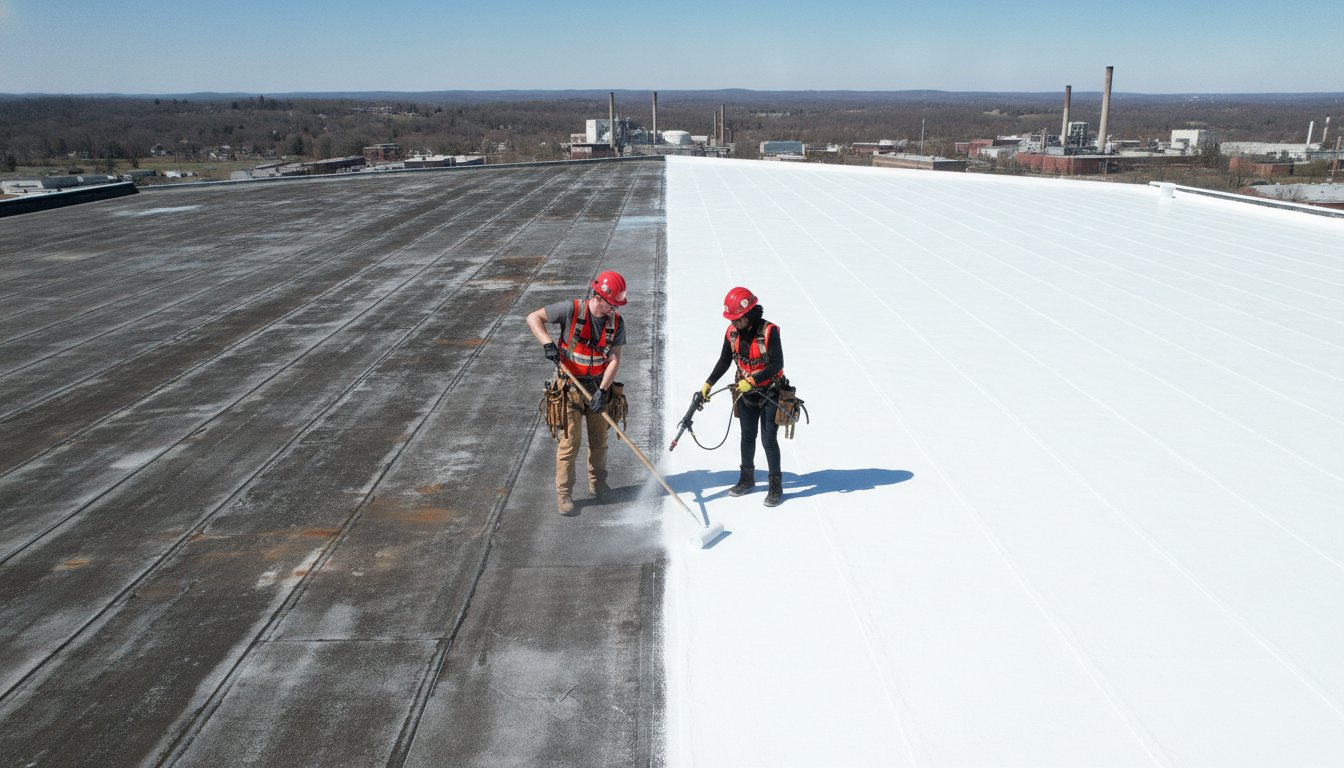
Total roof replacement is often a premature surrender of capital that ignores the structural potential of your existing system. For facility managers in the Lehigh Valley, industrial roof restoration Allentown is the tactical maneuver required to bypass the massive expense of a full tear-off while securing the building envelope. You understand that unpredictable leaks and thermal gain aren't just maintenance inconveniences. They're operational hazards that drain budgets and disrupt production schedules.
Restoring your roof is a decisive move that can extend asset life by 10 to 20 years and significantly lower cooling costs through high-reflectivity coatings. This guide serves as a comprehensive resource for evaluating restoration as a high-ROI alternative to replacement. We'll examine the technical protocols for fixing leaks with minimal downtime and the logistical advantages of asset extension in the 2026 industrial landscape. Expect a professional breakdown of how to stabilize your infrastructure and regain control over your facility's long-term maintenance trajectory.
Key Takeaways
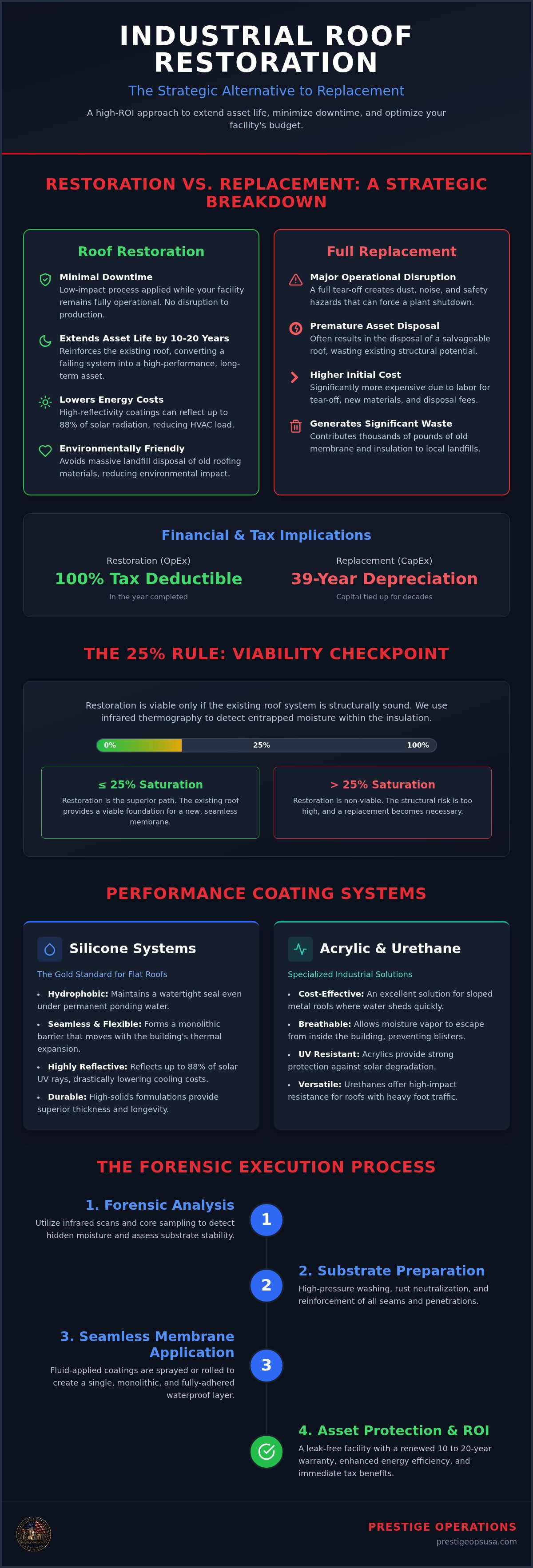
- Learn to map strategic decisions by distinguishing between high-cost CapEx replacements and tax-advantaged OpEx restoration.
- Discover how industrial roof restoration Allentown provides a seamless membrane that eliminates recurring leak repairs and operational downtime.
- Identify the specific performance coating systems, including silicone and acrylic, tailored for the unique structural demands of industrial facilities.
- Understand the forensic execution process, from infrared moisture detection to high-pressure surface preparation, ensuring a precision bond.
- Quantify the economic ROI through direct energy savings and a documented extension of roof life by 10 to 20 years.
Industrial Roof Restoration vs. Replacement: Strategic Decision Mapping
Industrial roof replacement is a high-cost, high-friction event. Many facility managers default to a total tear-off when leaks become persistent. This reactive mindset often results in the premature disposal of a salvageable asset. Industrial roof restoration Allentown provides a calculated alternative. It reinforces the existing building envelope without the logistical nightmare of a full construction site. It's a strategic pivot from emergency repairs to long-term asset stabilization.
The 25% Rule for Industrial Roofs
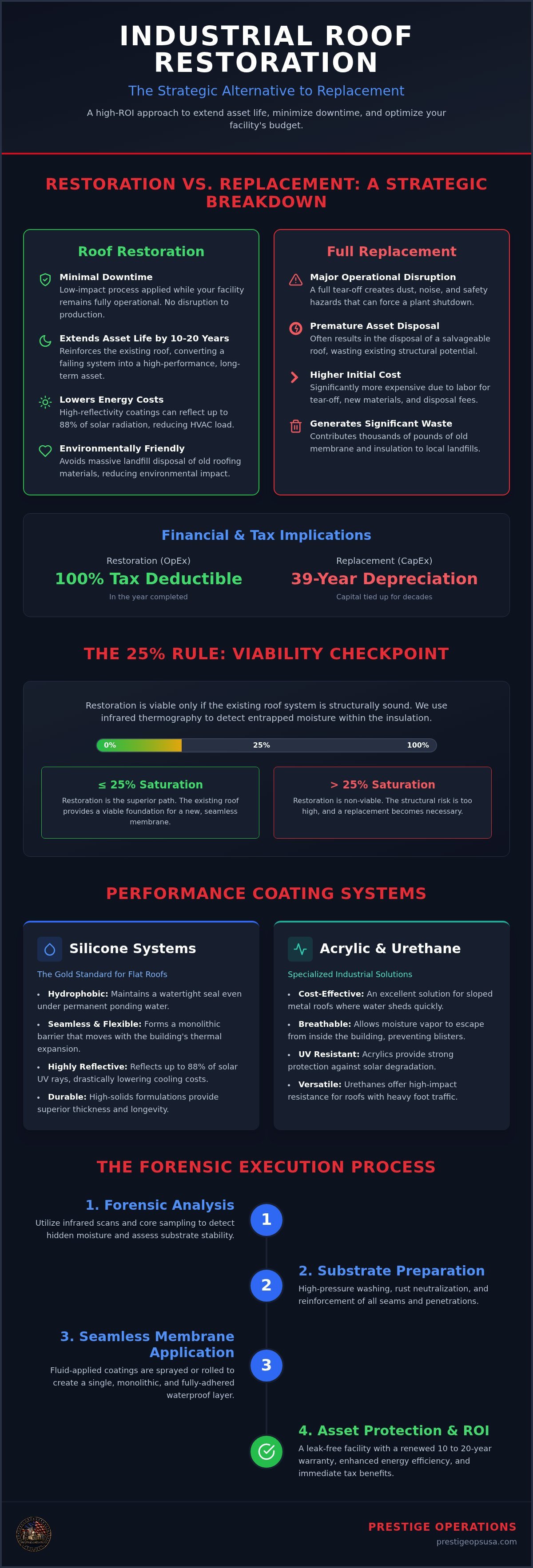
Restoration requires a viable foundation. We utilize core sampling and infrared thermography to identify entrapped moisture within the assembly. If more than 25% of the roof insulation is saturated, restoration becomes technically non-viable. The structural risk outweighs the coating's benefits. However, if moisture is contained below this threshold, restoration is the superior path. We first execute industrial metal roof corrosion treatment Allentown to neutralize rust and stabilize the substrate. This forensic preparation ensures the new membrane bonds perfectly to the existing deck. It converts a failing system into a high-performance asset.
Tax Incentives and Accounting Benefits
The financial distinction between CapEx and OpEx is a primary driver for restoration. A total roof replacement is a capital expenditure. Under current tax codes, it typically depreciates over a 39-year schedule. This ties up capital for decades. Restoration is classified as a maintenance expense. This often allows for a 100% tax deduction in the year the work is completed. It's a decisive accounting move. You gain a leak-free facility and a renewed warranty of 10 to 20 years while maximizing immediate cash flow. This high-ROI approach outperforms the slow depreciation of a new roof installation.
Operational continuity is the final tactical advantage. A full tear-off creates significant hazards. It produces dust, noise, and falling debris that can force a plant shutdown. Restoration is a low-impact process. We apply liquid membranes and reinforce seams while your facility remains fully operational. There is no disruption to production lines or logistics. You also avoid the massive landfill fees associated with disposing of old industrial membranes. Restoration keeps thousands of pounds of waste out of Allentown landfills while keeping your operations in motion. It's a clean, efficient, and highly professional solution for industrial roof restoration Allentown in complex environments.
Performance Coating Systems for Allentown Industrial Facilities
Selecting the correct chemistry is the most critical phase of industrial roof restoration Allentown. A generic approach leads to system failure. Industrial roofs in the Lehigh Valley face unique stressors: heavy industrial pollutants, extreme UV exposure, and rapid freeze-thaw cycles. We deploy fluid-applied membranes engineered to bond with specific substrates and withstand these environmental loads. Precision in material selection ensures the restoration survives the 2026 season and beyond.
Silicone Systems: The Gold Standard for Flat Roofs
Flat industrial roofs often suffer from ponding water. Most traditional membranes degrade when submerged for extended periods. Silicone is different. It's inherently hydrophobic. It maintains a watertight seal even under permanent ponding conditions. We prioritize high-solids silicone formulations for their superior durability and thickness. These systems provide a seamless, monolithic barrier that moves with the building's thermal expansion.
The reflectivity of silicone is a primary economic driver. By reflecting up to 88% of solar radiation, these coatings significantly reduce the "Urban Heat Island" effect common in Allentown's industrial corridors. This directly lowers the thermal load on your HVAC systems. If your facility manages temperature-sensitive inventory, evaluating a silicone restoration is a logistical necessity for asset protection.
Acrylic and Urethane: Specialized Industrial Solutions
Not every roof requires silicone. Acrylic coatings offer a cost-effective solution for sloped metal roofs where water sheds quickly. Their primary advantage is breathability. Acrylics allow moisture vapor to escape from the building interior while preventing liquid water from entering. This prevents blistering in environments with high internal humidity. We match the coating chemistry to the specific ventilation requirements of your facility.
Urethane coatings are the heavy-duty choice for high-traffic zones. If your roof hosts complex HVAC arrays or requires frequent maintenance access, urethane provides the necessary impact and abrasion resistance. It's an industrial-strength solution for the toughest environments. We often use a hybrid approach based on the specific needs of the deck:
- Acrylics: Best for UV protection and breathability on sloped metal substrates.
- Urethanes: Ideal for walkways, mechanical equipment staging areas, and high-abrasion zones.
- Compatibility: These chemistries bond effectively with aged EPDM, TPO, and weathered metal systems.
Allentown's industrial landscape demands a technical perspective. We analyze the chemical runoff from your facility and the specific pitch of your roof before recommending a system. Whether it's the chemical resistance of a urethane or the ponding resilience of a silicone, the goal remains the same: total building envelope security with zero operational disruption. We don't just apply coatings; we engineer long-term asset protection.
Economic ROI of Industrial Roof Coating Services in Allentown
Capital preservation is the ultimate objective for any facility manager. Industrial roof restoration Allentown converts a failing overhead liability into a predictable financial asset. It ends the expensive cycle of emergency repair spending. By deploying a fluid-applied membrane, you stabilize your building envelope and your maintenance budget simultaneously. This is a high-ROI maneuver that outperforms traditional roofing strategies over a multi-decade horizon.
Cool Roof Technology and Energy Performance
Energy efficiency is a direct byproduct of modern coating chemistry. White fluid-applied membranes reflect up to 85% of solar radiation. This prevents the roof deck from acting as a massive radiator that pumps heat into your facility. Lower surface temperatures mean rooftop HVAC units operate with significantly higher efficiency. They work less to maintain internal setpoints, which directly extends their mechanical service life. Reducing the thermal load on these units prevents premature compressor failure and lowers monthly utility expenditures.
Thermal shock is the rapid expansion and contraction of roofing materials caused by extreme temperature swings, leading to seam failure and fastener fatigue in Allentown facilities. High-reflectivity coatings mitigate this phenomenon. By maintaining a consistent temperature across the roof surface, the system experiences less physical stress. This stability protects the structural integrity of the underlying deck and prevents the shearing of mechanical fasteners.
Long-Term Cost Analysis: 20-Year Horizon
Restoration creates a renewable roofing system. Unlike a total tear-off, which has a finite lifespan and a high disposal cost, a fluid-applied system is sustainable. After 15 or 20 years, the membrane can be "re-charged" with a simple top-coat. This process resets the warranty clock without the need for a new installation. It allows you to bypass the disruptive and expensive cycle of industrial roof replacement Allentown PA. The total cost of ownership over 20 years is drastically lower when you factor in the avoidance of a second replacement cycle.
Maintenance costs drop to near-zero following a professional restoration. A seamless membrane eliminates the primary point of failure: the seams. You aren't just patching leaks; you're removing the architecture that allows them to form. Manufacturer-backed labor and material warranties provide a level of security that localized repairs cannot match. These warranties often cover up to 20 years of performance. You gain a leak-free environment, reduced energy bills, and a documented asset extension that strengthens your facility's balance sheet.
The Industrial Roof Restoration Process: Forensic Execution
Industrial roof restoration Allentown is not a cosmetic procedure. It is a technical overhaul that requires a disciplined, multi-stage protocol. We don't rely on visual inspections alone. Successful restoration depends on the integrity of the substrate and the precision of the preparation. Every phase of our execution is designed to eliminate variables and ensure a permanent bond between the new membrane and your existing roof deck.
Forensic Analysis and Moisture Detection
Precision starts with data. We utilize infrared thermography to "see" through the roof membrane and identify entrapped moisture within the insulation. This is a non-negotiable step. Coating over saturated materials leads to delamination and system failure. Once we locate moisture pockets, we perform surgical removals. We replace wet insulation with dry, matching materials to restore the system's R-value and structural stability.
Adhesion testing follows moisture detection. We apply sample patches of the specified coating to various sections of the roof. After a full cure, we conduct pull-tests to measure the force required to break the bond. This verifies that the chemistry is perfectly matched to your substrate. If the bond doesn't meet industrial standards, we adjust the primer or preparation method. We move forward only when the data confirms a successful application is possible.
Reinforcement of Critical Fail Points
The field of the roof rarely fails first. Leaks almost always originate at seams, penetrations, and transitions. We treat these areas as high-risk zones. Our teams reinforce every flashing, curb, and drain with heavy-duty industrial mastic. This creates a reinforced seal at the most vulnerable points of the building envelope. For metal or single-ply systems, we embed polyester fabric into the base coat at every seam. This "three-course" method provides the tensile strength needed to handle the building's natural thermal expansion and contraction.
Surface preparation is the final barrier to application. We utilize high-pressure washing at 3,000 to 4,000 PSI to strip away industrial pollutants, bird guano, and oxidized surface material. This creates a clean, etched profile that maximizes the surface area for the coating to grip. Once the surface is dry and the details are secured, we apply the fluid-applied membrane using precision spray equipment or heavy-duty rollers. We monitor wet film thickness throughout the process to ensure a monolithic, pinhole-free seal that meets manufacturer specifications. Request a technical consultation to begin the forensic assessment of your industrial asset.
Our final inspection protocol is rigorous. We verify that the membrane has achieved the required mil thickness across the entire deck. We pay close attention to the encapsulation of fasteners and the transitions at parapet walls. This methodical approach results in a seamless, watertight barrier that functions as a single, unified system. It is the only way to guarantee the 10 to 20 years of performance promised by industrial-grade restoration systems.
Prestige Operations: Allentown's Industrial Roofing Command
Success in the industrial sector requires more than general contracting. It demands logistical mastery and industrial-strength reliability. Prestige Operations focuses exclusively on high-stakes roofing requirements. We don't operate as a "friendly neighbor" service. We are a decisive strategic partner for facility managers who oversee complex, large-scale infrastructure. Our approach to industrial roof restoration Allentown is rooted in precision and physical asset protection.
Logistical mastery is our baseline. We understand that Allentown facilities operate on tight schedules. A roofing project shouldn't disrupt your supply chain or production lines. We execute large-scale restorations with surgical efficiency. Our teams move with a methodical rhythm that prioritizes your operational continuity. We manage the equipment, the materials, and the execution without creating administrative friction for your team. You get a stabilized roof system without the typical construction-site chaos.
Tactical Response for Allentown Facilities
Industrial infrastructure integrity is a non-negotiable requirement. Local Allentown businesses choose us because we lead with forensic evidence. We don't guess at the condition of your substrate. We use thermal imaging and core sampling to build a factual map of your roof's health. This boots-on-the-ground expertise allows us to take decisive action. We identify the exact failure points and neutralize them before they escalate into catastrophic losses. Our goal is total system stabilization, not just localized patching.
Facility managers in the Lehigh Valley face high-stakes decisions every budget cycle. Choosing the wrong partner leads to recurring leaks and wasted capital. We provide the technical depth required to manage these complex assets. We focus on the functional performance of the building envelope. This serious, technical register ensures that every decision we make is backed by industry-standard engineering and logistical capability.
System Integration and Long-Term Support
A successful restoration is the beginning of a long-term asset management strategy. We provide ongoing maintenance plans designed to validate and extend system warranties for decades. These aren't passive inspections. They are proactive tactical reviews that ensure your fluid-applied membrane continues to perform under Allentown's environmental stressors. We monitor the seams, the flashings, and the coating thickness to prevent future issues. If an industrial asset requires emergency attention, our response is fast and methodical. We prioritize the security of your facility and the continuity of your operations above all else.
Secure your building envelope and stabilize your maintenance budget for the 2026 season. Don't wait for the next storm to test your roof's integrity. Request a Tactical Industrial Roof Assessment to receive a forensic breakdown of your system's restoration potential. We provide the clarity and capability you need to manage your industrial roofing assets with absolute confidence.
Decisive Infrastructure Stabilization for 2026
Managing industrial assets requires a pivot from reactive repairs to tactical stabilization. Industrial roof restoration Allentown represents the most efficient use of capital for facilities facing aging membranes and rising energy costs. By deploying forensic moisture detection protocols, we eliminate the guesswork that leads to premature roof failure. You aren't just applying a coating; you're engineering a monolithic barrier that extends the system's service life by 10 to 20 years.
Our 100% roofing focus ensures that every technical decision is backed by specialized industrial roofing expertise. We understand the logistical complexity of high-stakes environments and move with a methodical rhythm that protects your operational continuity. It's time to stop chasing leaks and start securing your facility's future with a renewable, high-performance system. Secure your industrial asset with a tactical roof restoration plan today. You have the structural foundation; we provide the precision execution required to keep it in motion.
Frequently Asked Questions
What is the difference between industrial roof repair and restoration?
Repair is a localized response to a specific failure point. Industrial roof restoration Allentown is a comprehensive system application that creates a new, seamless membrane over the entire deck. While repairs fix individual leaks, restoration stabilizes the building envelope to prevent future failures. It's the difference between a temporary patch and a long-term asset extension that resets the system's service life.
Can any industrial roof be restored in Allentown?
Not every roof is a candidate for restoration. The primary limiting factor is the percentage of wet insulation within the system. If forensic moisture detection reveals that more than 25% of the substrate is saturated, a full replacement is usually the only viable option. We conduct core samples to verify that the underlying deck is structurally sound before recommending a fluid-applied system to ensure a permanent bond.
How long does an industrial roof coating last?
A professional restoration system typically lasts between 10 and 20 years. The specific lifespan depends on the mil thickness of the coating and the chemistry used. Silicone and urethane systems are often renewable. This means you can apply a new top-coat after the initial warranty period to reset the clock without a full tear-off. It's a sustainable cycle that keeps your facility protected indefinitely.
Is roof restoration in Allentown tax-deductible?
Restoration is typically classified as a maintenance expense rather than a capital improvement. This allows many businesses to deduct the full cost in the year the work is performed as an operational expense. Replacement is a capital expenditure that must be depreciated over nearly four decades. You should consult with your accounting team to confirm how this OpEx classification applies to your specific industrial facility's tax strategy.
Will roof restoration stop all my existing leaks?
Yes, restoration stops leaks by creating a monolithic, seamless barrier across the entire roof surface. The process includes pre-treating every seam, fastener, and penetration with heavy-duty mastic and fabric reinforcement. Once the fluid-applied membrane cures, it eliminates the joints and seams where leaks traditionally form. This provides total building envelope security and removes the structural architecture that allows water to penetrate the system.
How much does industrial roof restoration cost compared to replacement?
Restoration is a high-ROI alternative that avoids the massive costs of tear-off, specialized labor, and landfill disposal fees. While a full replacement requires significant logistical overhead and material removal, restoration utilizes your existing roof as a foundation. This reduces the total project cost significantly. It allows you to reallocate capital toward other facility upgrades while securing a manufacturer-backed performance warranty for up to 20 years.
Can you restore a metal roof with rust damage?
Rust doesn't automatically disqualify a metal roof from restoration. We utilize specialized rust inhibitors and primers to neutralize corrosion and prevent it from spreading. If the metal panels have maintained their structural integrity, a fluid-applied system will encapsulate the surface and prevent further oxidation. It's a decisive way to salvage an aged metal deck and avoid the expense of replacing individual panels or the entire system.
How do I know if my industrial roof is a candidate for coating?
A tactical damage assessment is the only way to confirm eligibility. We use infrared thermography and physical core samples to evaluate the condition of the insulation and the substrate. If the moisture levels are low and the deck is stable, your facility is a prime candidate for industrial roof restoration Allentown. This data-driven approach ensures the system will bond correctly and perform as an industrial-strength barrier for decades.