A commercial roof leak in Philadelphia isn't a minor maintenance task; it's a critical infrastructure failure that threatens your entire operational workflow. When water breaches the envelope, your facility faces immediate risks ranging from sensitive equipment damage to total business interruption. You need a decisive response, not a temporary patch. Securing a professional commercial roof leak repair Philadelphia specialist is the only way to ensure your asset remains protected under the 2021 International Building Code standards now enforced across the city. Delaying action only compounds the structural risk and increases the complexity of the eventual logistical recovery.
We understand the pressure of managing large-scale facilities where budget uncertainty and contractor reliability are constant concerns. You deserve a partner who operates with logistical mastery and technical precision. This tactical guide provides a high-impact checklist for Philadelphia facility managers to identify, mitigate, and resolve leaks with industrial-strength accuracy. We'll detail the forensic assessment process, outline local permit requirements for TPO and EPDM systems, and provide a clear roadmap for long-term asset longevity. From immediate leak cessation to professional damage mitigation, this is your manual for maintaining operational continuity in a high-stakes environment.
Key Takeaways
- Execute a 60-minute tactical response by securing the drip zone and marking forensic entry points to prevent immediate equipment damage.
- Learn to differentiate between internal water entry and the actual external source to ensure a successful commercial roof leak repair Philadelphia.
- Identify system-specific vulnerabilities, such as EPDM adhesive failure and TPO seam breaches, to address the root cause of industrial leaks.
- Utilize the "Rule of 25" decision framework to evaluate the cost-efficiency of technical repairs versus full-scale system replacement.
- Leverage professional forensic assessments to maintain compliance with the 2021 International Building Code and protect long-term asset value.
Immediate Leak Response: The 60-Minute Tactical Checklist
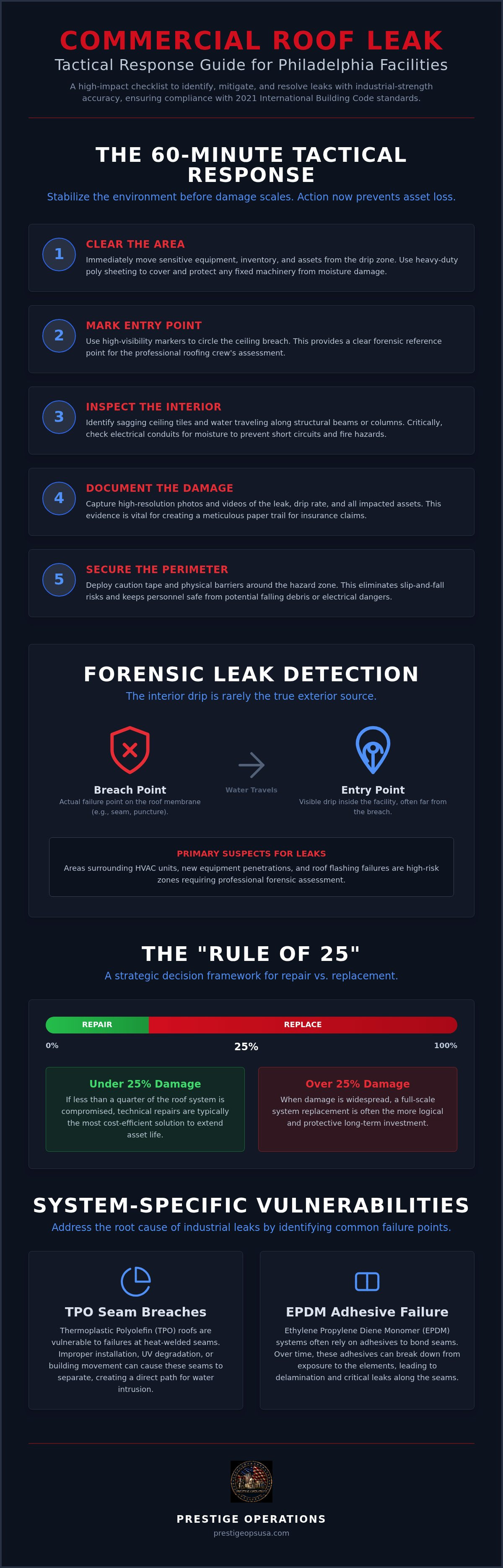
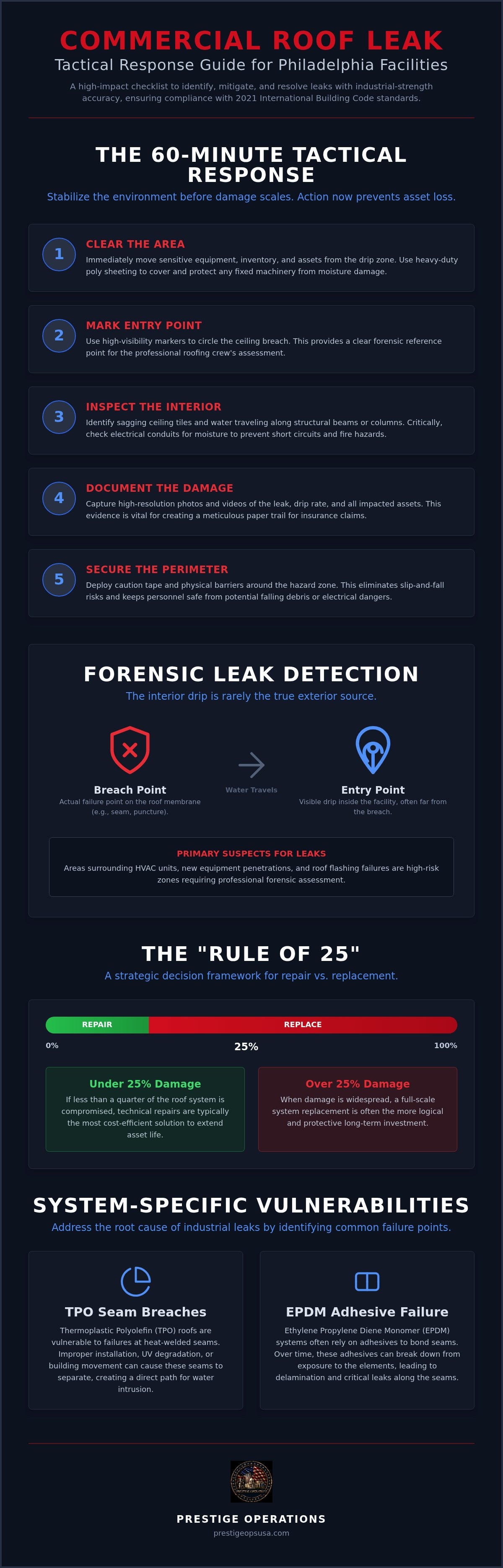
Water intrusion is a direct threat to your inventory and structural integrity. You've got 60 minutes to stabilize the environment before damage scales. This is the tactical baseline for any facility manager facing a breach. Immediate commercial roof leak repair Philadelphia depends on your ability to control the site before the crew arrives. Do not wait for the storm to pass. Action now prevents total asset loss and long-term structural degradation.
- Clear the area: Move sensitive equipment and inventory. Use heavy-duty poly sheeting for fixed machinery to prevent moisture damage.
- Mark the entry point: Circle the ceiling breach with high-visibility markers. This provides a clear reference for the roofing crew during the forensic assessment.
- Inspect the interior: Identify sagging tiles and water traveling along structural beams. Check electrical conduits for moisture to prevent short circuits.
- Document the damage: Capture high-resolution photos of the drip rate and all impacted assets. This evidence is vital for insurance and logistical records.
- Secure the perimeter: Deploy caution tape and physical barriers. Keep personnel away from the hazard zone to eliminate slip-and-fall risks.
Initial Damage Mitigation Protocols
Deploy industrial leak diverters to manage active water flow. These systems catch water at the ceiling level and channel it into drainage containers. This prevents floor saturation and sub-base damage. Identify electrical risks immediately. If water enters a breaker room or follows a conduit line, shut down power to the affected sector. Establish a detailed log. Note the exact time the leak started and the severity of the rainfall. This information helps roofing experts determine if the breach is related to a roof flashing failure or a failure in the primary membrane seams. Understanding the timing of the breach helps our team correlate the leak with specific wind directions or pressure changes during the storm.
Reporting and Documentation Standards
Industrial insurance claims require a meticulous paper trail. Create a comprehensive file including the leak log, high-resolution photos, and a list of impacted equipment. Capture forensic evidence of the leak's path before applying any temporary patches. This ensures the adjuster sees the full scope of the roofing failure. Notify all internal stakeholders and tenants according to your facility’s standard operating procedures. Clear communication prevents panic and allows for coordinated site management. A successful commercial roof leak repair Philadelphia relies on this initial data set. It provides the technical foundation for a permanent, industrial-strength solution. This data allows for a faster, more accurate forensic assessment once our boots are on the roof.
Forensic Leak Detection: Locating the Source
Finding a drip inside your facility is only the beginning of the diagnostic process. The visible entry point rarely aligns with the actual leak source. Water often travels significant distances along structural steel or roof decks before manifesting in the workspace. A successful commercial roof leak repair Philadelphia requires tracing this path with industrial precision to identify the precise failure point in the membrane. We look for the breach where the water enters the system, not just where it leaves the ceiling.
Analyze rooftop traffic patterns first. Areas surrounding HVAC units are high-risk zones where mechanical contractors often cause accidental punctures. Review your maintenance logs for any recent rooftop equipment installations or repairs. New penetrations are primary suspects for moisture intrusion. We examine the relationship between HVAC drainage and the primary roof slope. Poorly routed condensate lines can cause localized membrane degradation over time. All inspections and forensic walk-throughs must strictly follow OSHA fall protection standards to maintain site safety and regulatory compliance. It's the standard for professional accountability. If your facility shows signs of subsurface saturation, securing an industrial roof assessment is the next decisive step.
Thermal Imaging and Moisture Detection
We utilize infrared thermal imaging to identify trapped moisture that the naked eye cannot see. Wet insulation retains heat longer than dry materials; this creates a clear thermal signature during evening scans. Electronic leak detection (ELD) provides high-precision mapping for conductive systems. When subsurface damage is suspected, we perform core sampling. This physical extraction allows us to determine the exact level of deck saturation and insulation compromise. It provides the data needed to decide between a localized repair and a broader system intervention.
Common Philadelphia Commercial Leak Points
Philadelphia’s industrial infrastructure presents unique challenges. Aging industrial skylights and vents frequently suffer from degraded flashing. Urban buildings often feature internal drainage systems that clog with debris, leading to significant ponding water. This standing water accelerates the breakdown of adhesives in older systems. On older EPDM systems, membrane shrinkage is a common culprit. This tension pulls at the seams and perimeter flashings, creating gaps that allow water to bypass the primary barrier. These failures are often exacerbated by the local freeze-thaw cycles that characterize Pennsylvania winters. Addressing these specific vulnerabilities requires a "boots-on-the-ground" approach to ensure long-term asset protection.
Philadelphia Commercial Roofing Systems: Vulnerability Analysis
Every commercial roofing system possesses a unique failure profile. In Philadelphia, these technical vulnerabilities are exacerbated by a harsh industrial environment. Executing a successful commercial roof leak repair Philadelphia demands a deep understanding of these material-specific weaknesses. You cannot apply a universal fix to a specialized infrastructure problem. Your choice of repair method must align with the chemical and physical properties of the existing membrane.
TPO systems are widely utilized for their reflectivity and energy efficiency. However, they rely entirely on the integrity of heat-welded seams. If the initial installation lacked precise temperature control, these welds delaminate under thermal stress. Puncture resistance is also a critical concern. Standard 60-mil membranes are easily breached by dropped tools or mechanical debris during HVAC maintenance. We treat these breaches as high-priority entry points that require immediate stabilization.
EPDM membranes offer durability but suffer from inherent shrinkage. As the rubber cures over decades, it pulls away from the perimeter. This creates "bridging" that stresses the flashings and pulls the membrane out of its termination bars. Philadelphia’s freeze-thaw cycles accelerate adhesive degradation at the seams. Once the chemical bond fails, moisture enters the insulation package, leading to subsurface saturation that thermal imaging will eventually detect.
Built-Up Roofing (BUR) and Modified Bitumen systems face different threats. BUR fails when gravel scouring occurs. Wind and heavy rain displace the protective aggregate, exposing the bitumen to UV rays. This causes blistering, cracking, and "alligatoring" of the surface. Modified Bitumen joints suffer from fatigue. Constant expansion and contraction at the overlaps eventually break the seal, allowing water to wick into the felt layers. Identifying these signs early is the only way to prevent a full system failure.
Urban Climate Stressors on Philly Roofs
Philadelphia's urban core creates a high-acid environment. Industrial pollutants and acid rain react with membrane coatings, causing premature thinning and brittleness. Mid-Atlantic temperature swings are extreme. Rapid shifts from sub-freezing nights to hot afternoons create thermal shock. This stresses every transition and penetration point. Urban debris also poses a logistical threat. Bird nesting and wind-blown refuse frequently obstruct internal drainage systems. This leads to ponding water, which is the primary driver of membrane breakdown in flat roof assemblies.
System-Specific Repair Methods
Tactical patching is the standard for localized TPO damage. If the failure is systemic, we execute large-scale section replacements to restore the system's integrity. EPDM repairs require specialized re-seaming protocols. We utilize industrial-grade primers and heavy-duty adhesives to re-establish the bond. Multi-level commercial structures need reinforced flashing at every vertical transition. This prevents water intrusion at the most vulnerable geometric points of the roof assembly. Every repair is executed with the intent of matching the original industrial specifications of the building.
Strategic Decision Framework: Repair vs. Replacement
Financial logic must drive your facility management decisions. If the projected costs for a commercial roof leak repair Philadelphia project exceed 25% of the total replacement value, you've reached a critical pivot point. This "Rule of 25" prevents you from sinking capital into a terminal asset. We evaluate the industrial lifespan of your current membrane against the frequency of breaches. A 20-year-old EPDM system with recurring seam failures is no longer a candidate for tactical patching. It's a structural liability.
Operational impact is the secondary metric. Every leak risks tenant retention and damages high-value internal equipment. You must weigh the cost of a modern reflective system against the ongoing losses of a failing one. Upgrading to a high-reflectivity TPO membrane provides immediate energy efficiency gains. These systems reduce rooftop temperatures and lower the cooling load on your HVAC units. This transition turns a maintenance headache into a strategic asset improvement. Decisive action now prevents the exponential costs of a total structural failure.
Asset Life Extension Strategies
Strategic intervention can extend the utility of an aging roof when the deck remains dry. We utilize high-performance roof coatings to seal minor surface cracks and reflect damaging UV radiation. This approach is effective for systems that are structurally sound but reaching their surface wear limits. Implementing a comprehensive commercial roofing contractor Philadelphia maintenance plan is the best way to manage these assets. Routine inspections identify weak points in the flashing and drainage paths before they lead to catastrophic moisture intrusion. We reinforce these transitions to maximize the remaining industrial lifespan of your system.
Logistical Planning for Major Repairs
Execution in a dense urban environment requires logistical mastery. We minimize operational downtime by coordinating heavy equipment deployment and material staging with precision. Urban Philadelphia sites often have limited footprints for roofing cranes and debris containers. We manage these constraints through methodical planning and coordination with building security. Rapid execution is our priority. We stage all roofing materials to ensure a continuous workflow once the crew is on-site. This level of logistical control ensures your facility remains operational during the most complex repair or replacement projects. To determine the best path for your facility, contact us for a professional roofing assessment.
Prestige Operations: Philadelphia’s Industrial Roofing Authority
Prestige Operations operates with a boots-on-the-ground philosophy that prioritizes technical performance over personal connection. We manage complex, large-scale requirements for facility managers who demand industrial-strength reliability. Our team delivers commercial roof leak repair Philadelphia services with a focus on logistical mastery and asset protection. We serve the critical infrastructure of Philadelphia, Allentown, and Reading PA. We don't offer vague promises; we provide decisive action and direct communication on every roofing project. Our presence on your roof ensures your facility meets the 2021 International Building Code standards required for modern industrial assets. We understand the high stakes of commercial property management and operate with the precision necessary to protect your bottom line.
Our Tactical Repair Process
We execute a three-stage protocol to ensure permanent system stabilization. First, we conduct a comprehensive forensic assessment of the roofing shell and drainage paths. This identifies the root cause of moisture intrusion rather than just treating the symptoms. We analyze the entire roofing assembly, from the deck to the top-side membrane. Second, we perform the commercial roof leak repair Philadelphia using high-spec industrial materials tailored to your specific system. Whether you're managing a TPO, EPDM, or Built-Up system, we use materials that match or exceed the original engineering specifications. We don't use residential-grade patches. Finally, we conduct rigorous validation and testing. This includes seam probing and drainage flow analysis to ensure the system integrity is fully restored before we clear the site. Our process is designed to eliminate recurring issues and provide a definitive solution to water breach.
Securing Your Commercial Asset
Protecting your business operations requires a partner capable of handling significant complexity with ease. We invite you to review our portfolio of commercial and industrial roofing successes across the region. Prestige Operations is the strategic asset you need to maintain your facility's structural envelope. We don't just fix leaks; we manage the long-term health of your roofing infrastructure. Contact Prestige Operations for a no-nonsense damage assessment. We'll provide the technical data and logistical roadmap you need to make an informed decision for your roof. Our team is ready to deploy and stabilize your facility. Call us today to protect your business operations and secure your industrial asset against the elements.
Stabilizing Your Facility Infrastructure
Facility stabilization requires more than a reactive patch. It demands forensic precision and a deep understanding of your building's structural roofing shell. You now have the tactical framework to identify specific vulnerabilities in TPO, EPDM, and Metal systems. By applying the "Rule of 25" to your financial planning, you can move from emergency repairs to long-term asset management. Executing a precision commercial roof leak repair Philadelphia protocol ensures your facility remains compliant with the 2021 International Building Code and fully operational.
Prestige Operations delivers industrial-strength reliability for every industrial project. Our expertise in complex roofing assemblies allows us to handle significant logistical challenges with ease. We utilize Philadelphia-focused logistics to ensure rapid deployment and comprehensive asset protection. Your roof is a strategic asset. Manage it with the authority it requires to survive the Mid-Atlantic climate. Don't wait for the next storm to test your defenses.
Request a Tactical Roofing Assessment from Prestige Operations
Take control of your infrastructure and protect your operational continuity today. Our boots are ready to hit your roof and secure your business.
Frequently Asked Questions
How quickly can a commercial roof leak repair crew arrive in Philadelphia?
Response times depend on current logistical loads and site accessibility. We prioritize immediate stabilization for large-scale assets to prevent equipment damage. Rapid deployment is essential in the urban core. Our crews focus on securing the perimeter and stopping water intrusion. This allows for a full forensic assessment once the environment is controlled.
What are the most common causes of flat roof leaks in urban environments?
Mechanical punctures and clogged drainage systems are the most frequent culprits in urban Philadelphia. High-traffic roofs often suffer from dropped tools near HVAC units. Industrial pollutants also accelerate membrane thinning. When debris obstructs internal drains, ponding water creates hydrostatic pressure that forces water through weak seams or degraded flashing.
Can a leaking commercial roof be repaired in the rain or winter?
Tactical stabilization occurs regardless of the season, but permanent repairs require specific environmental windows. TPO heat-welding and adhesive applications for EPDM need dry surfaces for proper bonding. We utilize specialized cold-weather materials during Pennsylvania winters. These industrial-grade solutions ensure the repair holds even when temperatures drop below freezing.
Does a roof leak always mean the entire system needs replacement?
Replacement is only required when the cost of technical repairs exceeds 25% of the total system value. Most leaks are localized failures at the flashing or seams. We use forensic tools to determine if the insulation is saturated. If the deck remains structurally sound, a targeted repair is the most efficient path for asset protection.
How much does an average commercial roof leak repair cost in Philadelphia?
Costs for a commercial roof leak repair Philadelphia project are dictated by material type and site logistics. Local labor rates in the city average about 18% higher than the Pennsylvania state average. Factors like rooftop equipment density and permit requirements also impact the final investment. Every project requires a specific assessment to determine the necessary logistical scale.
What type of warranty is provided on industrial roof repairs?
Warranties for industrial roofing work vary based on the repair scope and the materials used. Localized patches typically carry a workmanship warranty. Full system restorations often include manufacturer-backed NDL warranties that cover both labor and materials. We provide clear documentation of all technical specifications and coverage limits before the project starts.
How does thermal imaging help in detecting commercial roof leaks?
Infrared thermography detects heat retained by wet insulation long after the sun goes down. This allows us to map the precise boundaries of subsurface moisture without cutting into the membrane. It's a non-destructive method for identifying the true extent of a leak. This data ensures we only replace the saturated sections of your roofing system.
Will insurance cover the cost of my commercial roof leak repair?
Commercial policies generally cover water intrusion caused by sudden, accidental events like wind or hail. Leaks resulting from aging membranes or lack of maintenance are usually excluded. It's vital to provide high-resolution forensic evidence for your commercial roof leak repair Philadelphia claim. We provide the technical documentation needed to support your insurance provider's assessment.